
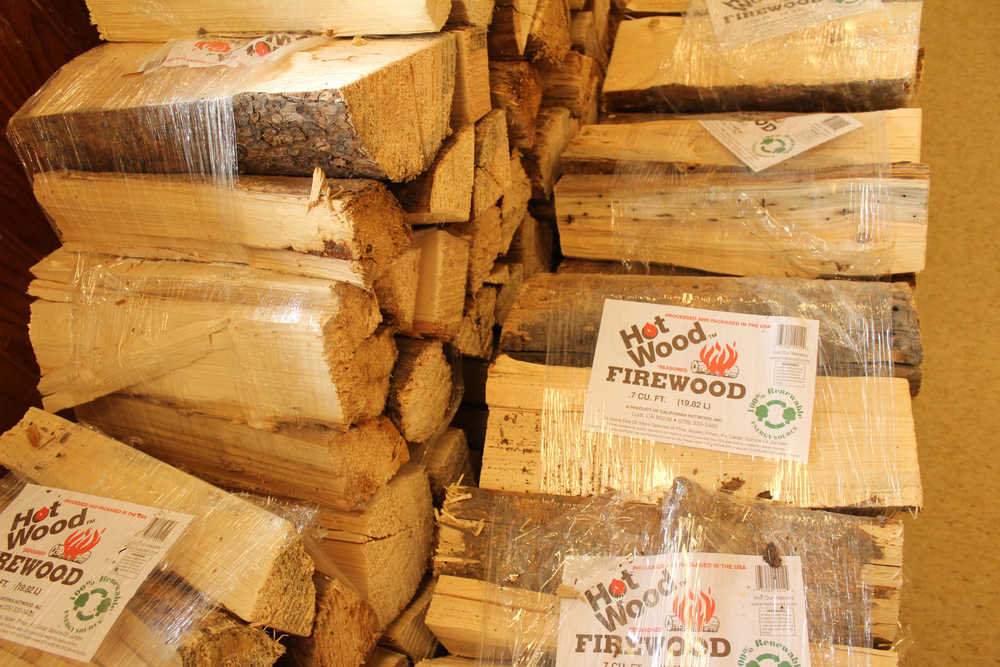
Remember a few years ago when one of the local chain stores in Juneau tried selling Atlantic farmed salmon from down south? Oh, the hue and cry of public outrage. So they stopped. We should marshal that activism to put the brakes on firewood that comes from Outside. Forests all over the world are getting hammered by invasive species brought in this way and here we are in the middle of the nation’s largest forest as Superbear and Foodland sell firewood bundles from Oregon. Safeway sells firewood bundles from California. Fred Meyer sells firewood bundles from South Central Alaska (where the massive die off from spruce beetles is) and they sell birch rounds—with bark on—from Latvia. Latvia?
Some of the smaller stores carry locally sourced wood. Breeze In does. Western Auto sells both local wood and British Columbia wood by the bundle. They also sell 1/3 cord bags of local wood. Individual wood bundles are the most expensive way to buy firewood. A cord of wood is 128 cubic feet. A bundle of Outside wood runs anywhere from $5 to $7 dollars. Most of the Outside bundles are about 0.7 cubic feet of wood, which means it would take about 182 of them to make a cord. Figuring 6 dollars a bundle, buying wood this way you’re paying about $1,100 per cord or $367 for 1/3 cord. AK Reuse on Shaune Drive sells 1/3 cord bags of local wood for $85.
Keeping contaminated wood products out of here is important because the Achilles heel of this great Southeast Alaska forest is low tree species diversity. Most of the green you see on the mountainsides is spruce and hemlock. This year spruce trees are raining dead needles because last winter wasn’t cold enough to knock the spruce aphids back. Spruce aphids are a tiny invasive species that came to the Pacific Northwest on nursery stock from Western Europe a hundred years ago. By the mid-1930’s they had spread to Wrangell. Now they’re all over the place and they’ve moved into other tree species. They’ve defoliated more than 150,000 acres of Engelmann spruce since they made it to the American Southwest in the 1970s. The ‘Don’t Move Firewood’ website says mortality in Engelmann’s can range from 24 percent to 40 percent in five years.
In 2002, Asian emerald ash borer beetles rode wooden pallets, made in Asia of beetle killed ash trees, into Detroit. When ash trees began dying there people didn’t know the cause. They cut up the dead trees and took them camping for firewood. Our local U.S. Forest Service entomologist Elizabeth Graham, who is a wealth of information, said researchers were able to trace the spread of ash die off in Michigan by going to public campsites in expanding circles around Detroit. They were even able identify and call people to ask, “Did you bring firewood to such and such campsite?” And people would say, “Yes, I did.” In this way Asian emerald ash borers spread all over the state and kept going. They are now established from Ontario to Louisiana and Colorado to New Jersey. They’ve killed hundreds of millions of trees in North America. These beetles are the culprits behind whole ash forests in Europe dying from blight as they have been trucked from country to country in nursery tree stock. Ash blight is caused by a combination of emerald ash borer beetles and an Asian sac fungus. About 90 percent of Denmark’s ash trees are infected. In England, where ash is the second most abundant tree and more than a thousand species are connected to them, a recent headline from the BBC was, ‘Ash trees set for extinction in Europe.’ Some loggers say, “Well, all righty then. Fire up the chainsaw,” but clear cutting isn’t the answer; the bugs get spread all around when you’re skidding the trees out. Also, you might cut down ‘Betty’ without realizing what you’ve done. Betty is a 200-year-old ash tree in Northfork, England that is somehow resistant to the blight. She may be the key to saving ash trees on both continents.
For hitchhiking disease and insect vectors, firewood is a sweet ride. Firewood is what you do with deformed and dead trees. What made them dead and deformed in the first place is likely in that wood wrapped in plastic outside Juneau stores. And it’s not only stores. There’s at least one large vessel headed to Juneau from Washington state this year with cords of cut firewood. All it would take is one infested tree. Dutch Elm Disease came in on a load of logs from the Netherlands in 1928. Then, as now, the global economy rewarded enterprise in people with zero ability fix the damage they cause. Some entrepreneur’s idea to make money using Dutch logs for veneer killed over 75 percent of elms in North America.
In Southeast Alaska we’ve been remarkably lucky so far. Elizabeth Graham says there are even more scary things out there. Asian gypsy moths, for instance, are adaptable to more than six hundred host species. They travel in logs, nursery stock, pallets etc. and are one of the most serious threats to Alaska forests. Inspectors have found gypsy moth egg cases aboard ships in Alaska waters. They didn’t come ashore—for now. Biologists are doing what they can for our big forest with inspections, trapping stations and public alerts, but what’s really needed is us, the public, politicians, loggers, tree huggers and all. All of us who care about the place should push to keep invasives out and get our wood close to home.
• Dick Callahan is a Juneau writer. In April 2016, he won first place in the Alaska Press Club Awards for best outdoors or sports column in the state.
