
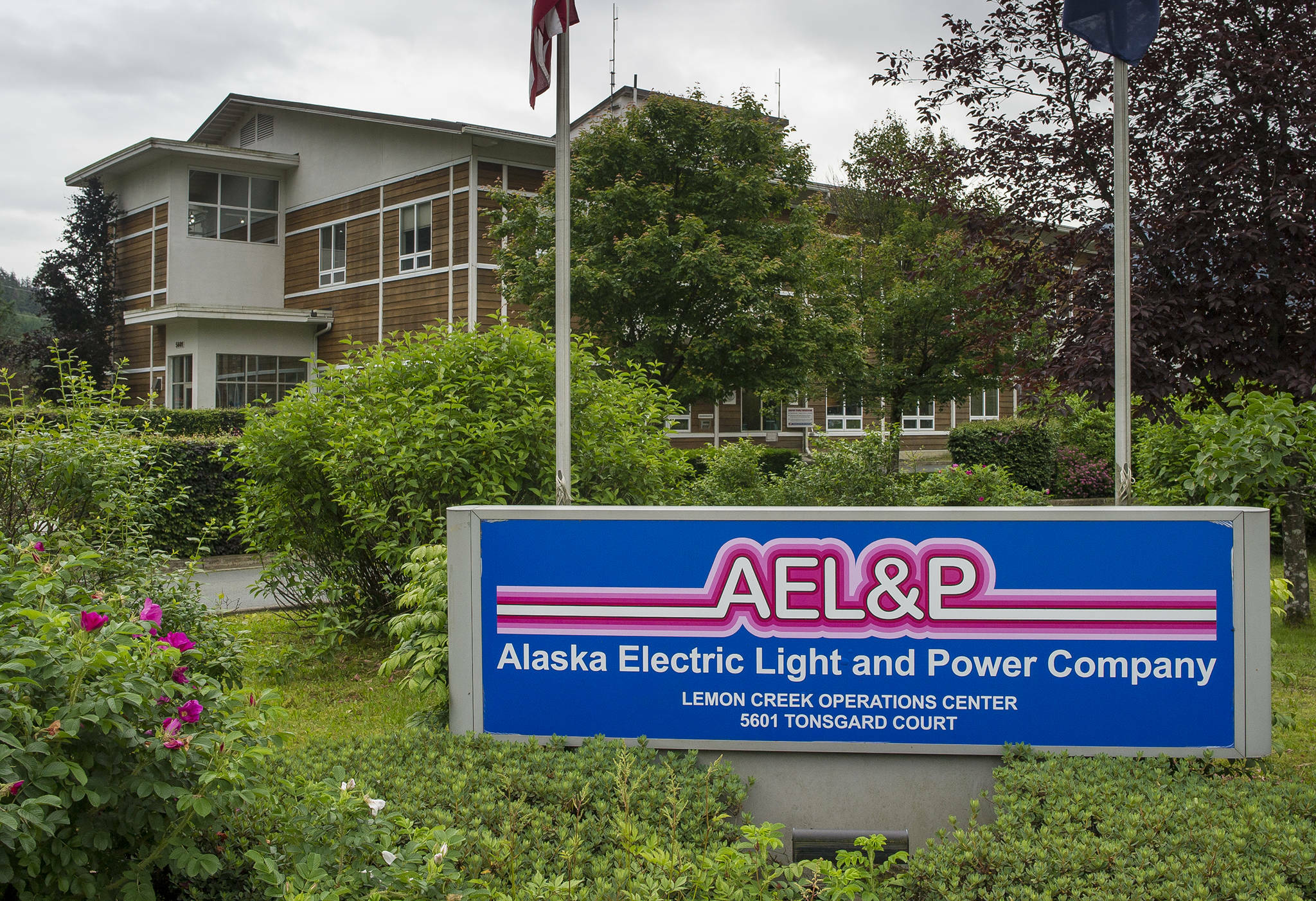
New local electricity rates are in effect as of Wednesday, ranging from a 0.15% decrease for small commercial users to a 5.36% increase for streetlight rates — completing a process that includes a 4.5% increase for all customers that took effect last September, Alaska Electric Light and Power Co. announced this week.
The rate for residential customers increased 2.61% on Wednesday, for a total increase of 7.11% since last September. Debbie Driscoll, an AEL&P spokesperson, said Friday it is the company’s first rate increase since 2016 and notes a 6.73% decrease for all customers occurred in 2018.
She also said residential rates are getting a bigger overall increase than commercial rates to even out how much all customers pay for their power usage.
“Small business and large commercial have been subsidizing residential rates in the past, and it’s being corrected now,” she said.
The recent (and cumulative) increases for AEL&P’s four categories of customers are 2.61% (7.11%) for residential, -0.15% (4.35%) for small commercial; 0.29% (4.79%) for large commercial and 5.36% (9.86%) for streetlights. The cumulative average for all customers during the 15-month period is a 6% increase.
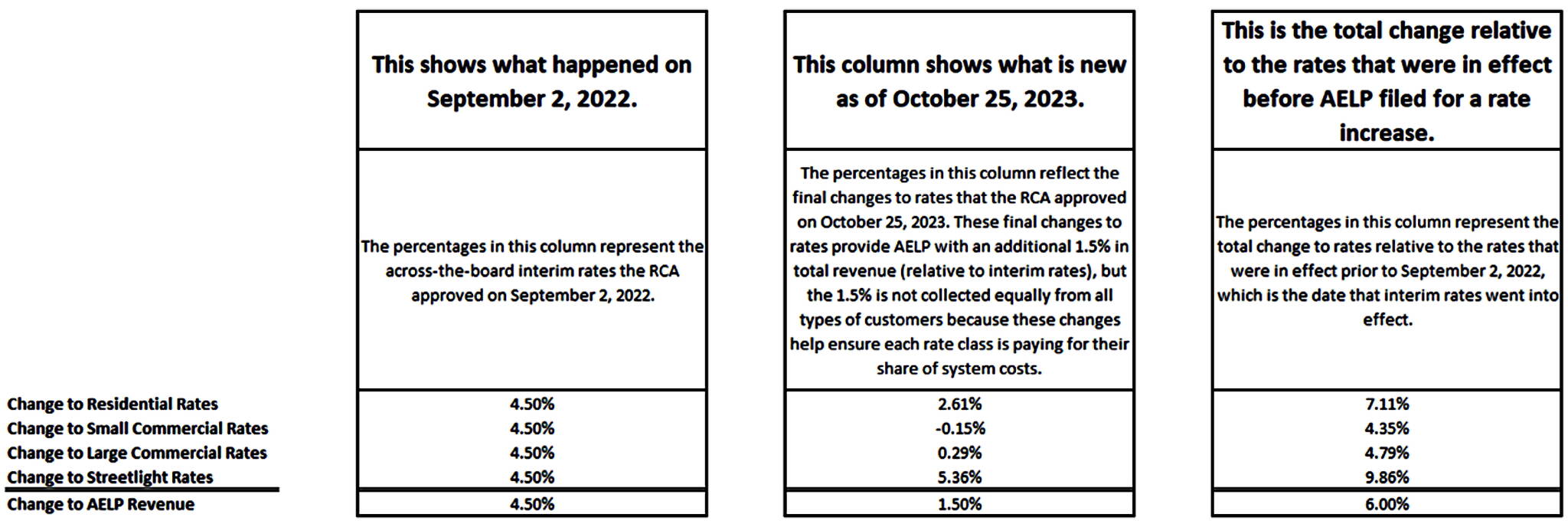
A chart at Alaska Electric Light and Power Co.’s website shows the two-step change in rates for various types of customers since last year. (Screenshot from Alaska Electric Light and Power Co. public announcement)
The new kilowatts-per-hour peak rates between November and May are 12.29 cents for general residential, 11.78 cents for small commercial, and 6.22 cents for large commercial, according to the company’s website. Streetlights are assigned an annual cost based on their wattage and type.
The company states a residential customer using an average of 750 kWh a month will see a monthly increase of $2.72 during peak winter rates and $2.40 during the lower-rate months from June through October.
The increases are based on a request submitted to the Regulatory Commission of Alaska by AEL&P on July 15, 2022, and typically occur in a two-step process with an interim increase 45 days after the filing and the second 15 months after the filing, according to a press release by the company.
The release also states inflation has increased more than 15% between 2016 and when the increase was requested, and the company invested more than $53 million for system additions and upgrades during that period. Driscoll said additional factors go into calculating rate increases — and how much they are for four different customer types.
“It’s a really complex formula where you’re entering all of your costs,” she said. “It’s the investments in new infrastructure, your operating and maintenance expenses, your interest expenses — everything that you can imagine that goes into a business.”
“So all those numbers get pulled together and then it’s divided, I believe, by kilowatt hours — the actual usage for the year — and you determine ‘OK, what is the per kilowatt hour charge based on all of these costs?’ And I’m really oversimplifying it.”
Determining rate adjustments for each category of customer is based on actual costs during the year before filing an increase request, Driscoll wrote in an email to followup questions after the interview.
“Different types of customers make different demands of the electric system, and the costs associated with maintaining and operating the system vary over time,” she wrote. The difference between the changes in commercial and residential rates in this instance occurred because “AEL&P’s study showed that the revenue collected from commercial customers exceeded the costs that were fairly allocated to them, and the revenue collected from residential customers fell short of the costs fairly allocated to them.”
The notably higher increase for streetlights is also based on that data, Driscoll stated.
“Streetlights have a higher percentage of costs that are directly allocated solely to that use than what is seen with residential and commercial customers, and the cost-of-service study performed for this rate case showed that costs to provide the service inflated to a greater extent than for residential and commercial customers,” she wrote.
The decrease in 2018 was possible due to the federal Tax Cuts and Jobs Act, whose provisions included a significant corporate tax reduction, which resulted in more than 100 U.S. utility companies lowering their rates, according to The Center For Public Integrity.
“AEL&P is sensitive to the effect this rate increase may have on our customers,” the company’s press release states. “A credit counselor and energy services specialist are available to help customers find ways to reduce their usage, make payment arrangements, and connect with community resources that can help customers pay their bills. Additionally, customers can find helpful information on managing energy use at www.aelp.com.”
• Contact Mark Sabbatini at mark.sabbatini@juneauempire.com or (907) 957-2306.
