
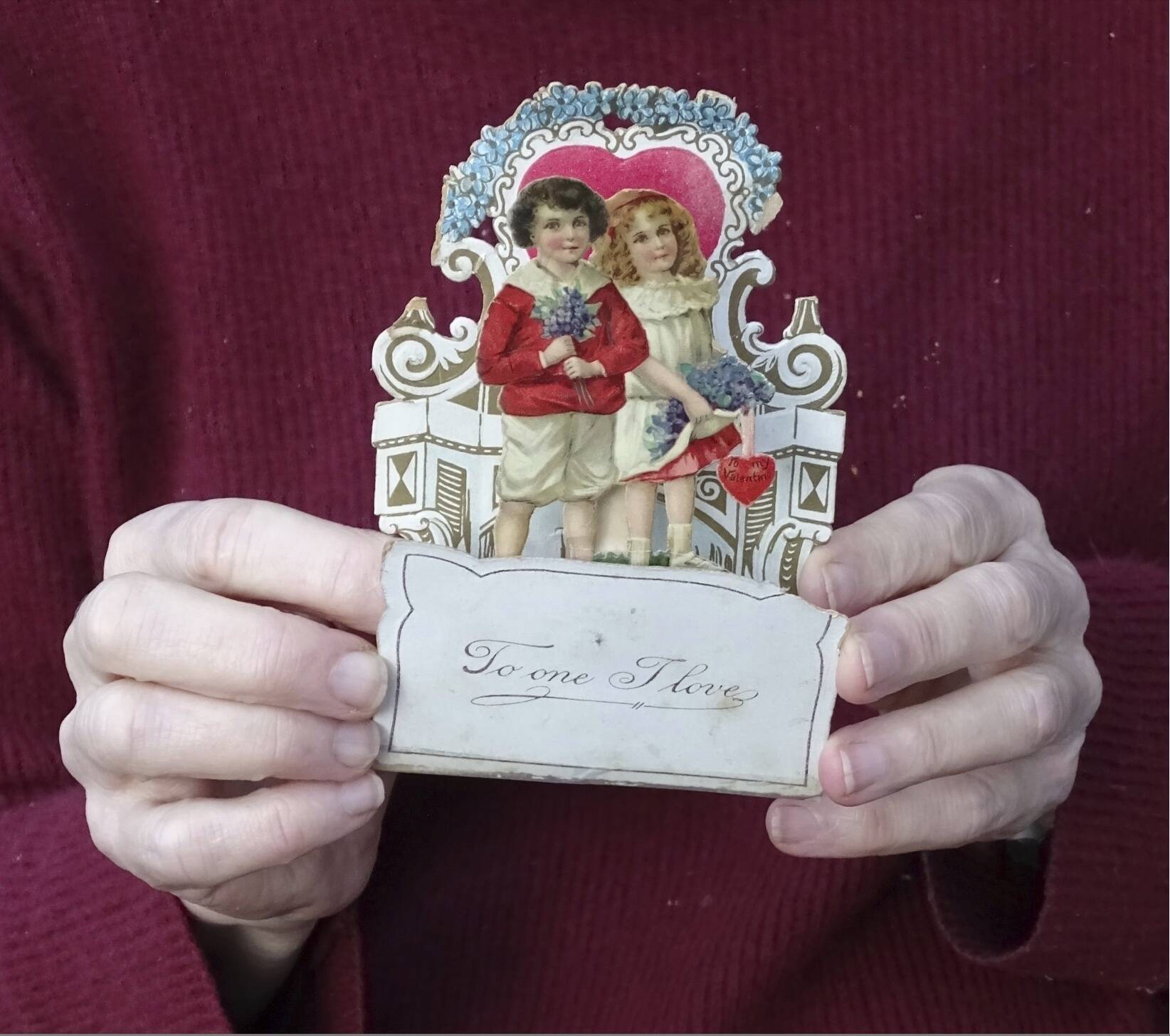
It was Valentine’s Day 1917 in the Minnesota farming village of Lewiston, and Fred Roth — a fourth grader — seems to have come up with just the way to express his love for his sweetheart, Louise Wirt. He gave her a card.
The folding, pop-up Valentine’s Day card, on stock so heavy it remains in good shape 106 years later, reads: “Forget me not!/I ask of thee/Reserve one spot/In your heart for me.”
And so she did. Years later they married, and Louise displayed the cherished card, tucked into the fretwork of a bedroom dresser, for decades to come. She pointed it out to her daughter, and later to a granddaughter, me, and it remained near her bedside until her death at 91, a token of lasting love.
Although the message was in English, the card is printed with the word “Germany” and is seemingly imported, as were many cards of that era. Small companies in the U.S. also were part of a flourishing commercial card business.
Hallmark, which began offering Valentine’s Day cards in 1913, estimates that today, 145 million Valentine’s Day cards are exchanged annually, not including the kids’ valentines popular for classroom exchanges.
Fertility-related customs and rituals have been celebrated in mid-February since pagan times, says Emelie Gevalt, curator of folk art and curatorial chair for collections at the American Folk Art Museum in New York City.
Tokens of affection varied: In the 1600s, the practice was to give pairs of gloves in mid-February, she says.
“By the 18th century, we start to see something that really begins to resemble modern Valentine’s cards,” she says. “In the 19th century, this evolved further to the point where popular ladies’ magazines like Harper’s Weekly published instructions for readers on how to craft them.”
There have long been both earnest, heartfelt Valentines like Grandpa Fred’s, and ones in a more teasing, playful vein.
The museum’s collection includes a number of lovingly crafted tokens of affection from various periods. “You see the heart motif quite a lot,” Gevalt says.
Although not specifically linked to Valentine’s Day, an exhibit at the museum opening March 17, “Material Witness: Folk and Self-Taught Artists at Work,” features two examples of “fraktur,” exuberantly decorated watercolors made by German immigrants in Pennsylvania. One is called “Inverted Heart,” and another depicts a labyrinth.
“They were really dazzling objects, including motifs of flowers or hearts. The playfulness and cleverness of these objects is one of the most interesting aspects they have in common,” Gevalt says.
In the mid-19th century, some people shared “Vinegar Valentines,” a sort of anti-Valentine that featured playfully insulting verses, not unlike a modern-day roast.
Sometimes, cards involved writing in a circle or upside down, like a puzzle. Some had a decorative folded border or verses on the folds; cutwork resembling lace; or watercolor decorations of pierced hearts, lovebirds and flowers. Lover’s knots and labyrinths were also common elements.
“They remind me of games, like plucking the petals of a flower saying ‘she loves me, she loves me not,’” Gevalt says.
The boom in commercial Valentine’s Day cards in the mid-1800s was a reflection of changing courtship patterns, says Elizabeth White Nelson, associate professor of history at University of Nevada, Las Vegas.
“The idea of companionate marriage and love became a part of the calculus of marriage, and Valentine’s Day cards became a part of courtship,” she says.
These days, the cards continue to evolve.
“Over the last few years, trends have been less about romantic love but more about letting someone know they matter,” says Jen Walker, vice president of trends and creative studios at Hallmark Cards, Inc.
There are “more inclusive visuals, and a larger representation of relationships — love, chosen family, friendships, parents and children, self-care,” she says.
A bit of mystery surrounds my Grandma Louise’s precious Valentine. It would have been out of character for Fred to buy a commercial card as opposed to, say, presenting her with a bouquet of pussy willows he had picked.
“That period would have been the beginning of an organized practice of exchanging Valentines in school,” says Nelson. In some classrooms, everyone was required, or at least encouraged, to give a Valentine.
“The giving and receiving of Valentines was always partly about performing love, for an audience,” says Nelson, “and once that Valentine’s Day card got saved, it would have become a talisman of all that love is supposed to be.”
