
Crafting a compromise education spending and policy package will be attempted during the next two weeks by a five-person group consisting of state legislative leaders and a senior member of Gov. Mike Dunleavy’s staff, lawmakers at the Alaska State Capitol said Monday.
The group will include one lead member from each of the House and Senate majority and minority caucuses, plus Dunleavy legislative director Jordan Shilling, according to Senate President Gary Stevens, a Kodiak Republican. He said a limited number of other lawmakers and staff — such as a Legislative Finance Division expert — will also be present at the meetings expected to start Tuesday.
”I think there’s a reason to be optimistic,” Stevens said. “The governor has called us together. He wants to find a negotiated agreement. He said very clearly ‘If we can work this out I will not veto anything.’”
Talks will begin with wide divisions between the Republican governor and the Democratic-led bipartisan majority legislative caucuses. A House majority bill is seeking to boost per-student spending more than 20% next year and 40% in three years, while Dunleavy on Friday unveiled a bill with a multiple of targeted policy proposals and no per-student funding increase.
Previous efforts to resolve similar differences have failed in past years, with Senate Rules Chair Bill Wielechowski, an Anchorage Democrat who took part in education negotiations last year, telling KTUU last week “it’s challenging to negotiate with someone who you feel like you have a deal with and then they just change their mind at the last minute.” But Wielechowski, who will be the Senate majority representative on the new working group, said Monday he will approach the discussion with hope.
“I don’t think the governor would call us all together and have us spend all this time if he wasn’t negotiating in good faith,” he said.
Stevens said Dunleavy called the meeting with legislative leaders on Thursday, the day before the governor unveiled his bill during a press conference where he at length denounced “the other side” as caring only about money. Among the policy changes in his $181 million education package are allowing the state to authorize new charter schools instead of leaving that decision up to school districts, boosting correspondence school funding and allowing students to attend any public school statewide regardless of their hometown.
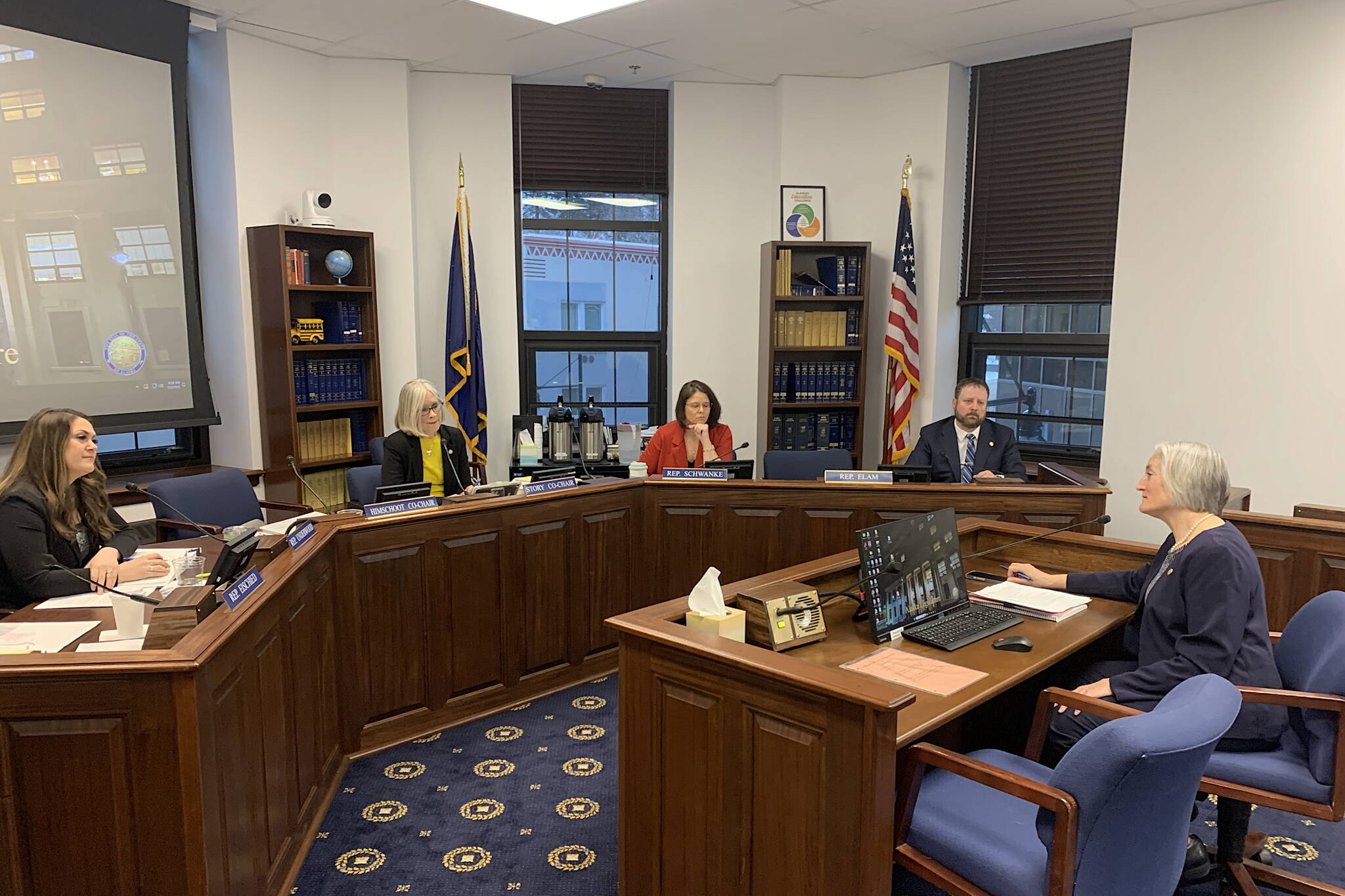
The House Education Committee, meanwhile, spent Monday morning debating House Bill 69, which would increase the statutory Base Student Allocation of $5,960 to $7,249 next year (at a cost of about $325 million) and to $8,510 in three years (about $650 million more than this year’s funding). Supporters of the bill argue the BSA has increased 6.8% since 2010 while inflation has increased 39.2% during that time, resulting in districts statewide facing crises that are resulting in school closures and other hardships.
HB69 was being expedited by the House majority, but plans to advance it to the House Finance Committee — its last stop before a floor vote — on Thursday were halted due to pending discussions by the new working group.
House Speaker Bryce Edgmon, a Dillingham independent who will be the lead member of the working group for the House majority, said one of the goals will be coming up with a plan relatively early in the session so school districts have time to factor any funding and other changes into their budgets for the upcoming fiscal year that starts July 1.
“I think it’s an effort to really capitalize on this commonly held view that the funding is definitely needed for school districts, but there’s also again the governor’s direction that some policy items that need to be forthcoming with it,” he said.
In addition to Wielechowski, a secondary Senate majority participant in the group will be Löki Tobin, an Anchorage Democrat who chairs the Senate Education Committee. The lead Senate minority caucus member will be Mike Cronk, a Tok/Northway Republican on the Education Committee and the second member will be Sen. Shelley Hughes, a Palmer Republican who was the Senate Majority Leader from 2021-22.
The secondary member of the House majority will be Rep. Rebecca Himschoot, a Sitka independent who co-chairs the House Education Committee and sponsored HB69. The primary House minority member will be Rep. DeLena Johnson, an Anchorage Republican on the House Finance Committee and the secondary member Rep. Justin Ruffridge, a Soldotna Republican who co-chaired the House Education Committee last session.
A statement issued Monday afternoon by Dunleavy’s office notes he “is encouraged that lawmakers from all four caucuses have agreed to hold meetings this week to try and negotiate an education policy and funding bill that all sides can agree to and pass.”
“School choice, improving educational outcomes and increased school funding are among the governor’s top priorities for the 34th Alaska Legislature,” the statement adds. “By working together with lawmakers, it is possible to achieve all three this session.”
Legislative leaders on Monday declined to detail specific “red line” items they would bring to the table, stating the intent is to keep all options open as discussions begin.
“There’s the side that wants just the money and there’s the side that wants policy and there’s those of us in the middle that kind of wants to get a compromised approach,” Senate Minority Leader Mike Shower, a Wasilla Republican, said Monday. “This is a chance to try to do that. Let’s see what happens.”
• Contact Mark Sabbatini at mark.sabbatini@juneauempire.com or (907) 957-2306.
