
SEATTLE — Capt. Eric Haroldson calls the research ship he commands “the Buddy Hackett of oceanographic research.”
“It’s kind of boxy,” he said of the gray, 274-foot-long Navy-owned ship, the R/V Thomas G. Thompson. “It fits together kind of weird.”
But what the Thompson lacks in style, it makes up for in utility: It’s the workhorse for the University of Washington’s School of Oceanography, and has had a starring role in groundbreaking oceanographic discoveries in the Pacific Ocean.
The ship has helped scientists study kelp forests in the Aleutian Archipelago and harmful algal blooms in the Pacific Northwest, the Seattle Times reported. It has allowed researchers to watch volcanoes erupting underwater, discover and document never-before-photographed fish living at the bottom of the ocean, and collect rocks and core samples of sediment 10,000 feet below the surface.
As one of only three such oceanographic research vessels of its size and capacity in the U.S., it provides a rare experience for undergraduate and graduate students at the UW to take part in scientific research at sea.
Now, the Thompson is heading into dry dock for a yearlong, $34.5 million overhaul that will be paid for by the U.S. government and extend its life by another 25 to 30 years.
It will get new diesel engines and new controls from bow to stern — pipes, cables, sewage system, alternators, circuits and new digital equipment for navigation.
“She’s a great boat, and it’ll be good to get back on board,” said Deborah Kelley, professor of oceanography and director of the Ocean Observatories Initiative’s Cabled Array, a network of sensors attached to cables that transmit data instantly and continuously from the seafloor.
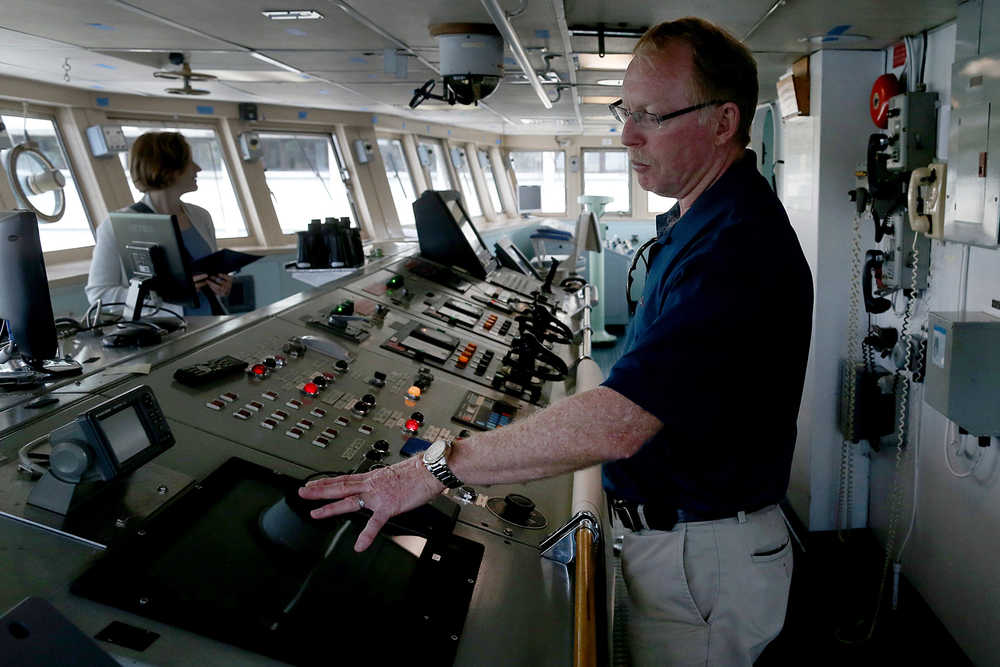
Built in 1990 at a cost of $30 million, the Thompson was constructed at the end of the analog era, said Haroldson, one of two men who serve as its captain. Many of its controls are old-fashioned dials, switches and push buttons.
The overhaul will bring the ship into the digital age, with modern equipment that takes up less room but is easier to use, said Doug Russell, manager of marine operations for the UW.
In recent weeks, the crew has been moving equipment off the Thompson — everything from sophisticated lab equipment to bed mattresses. Stripped-down, the ship is ready to be moved to dry dock on Harbor Island, where it will be renovated by Vigor Marine.
The Thompson was used to install the groundbreaking Cabled Array, a suite of 140 instruments located 300 miles off the coast of Oregon that allow scientists to watch a seismically active part of the seafloor in real time. The array is funded by the National Science Foundation and was installed in 2014-15.
From Seattle, the ship has sailed as far south as the southern tip of Chile and as far north as Dutch Harbor, Alaska. It has crossed the Pacific, traveling to Guam, Samoa, French Polynesia and New Zealand.
Although it’s operated by the UW, its trips are funded largely by the National Science Foundation. It is used by scientists from around the world, who vie for research time on the Thompson through written proposals. The state of Washington also funds 45 days of ship-research time each year for UW undergraduates and graduates, said Ginger Armbrust, director of the School of Oceanography.
When it is in operation, the ship is out to sea 260 to 300 days a year. Armbrust said the Thompson has a top-notch crew; Haroldson, the captain, started as a third mate in 1999 and worked his way up to become captain.
Although the Thompson’s controls are analog, there’s lots of high-tech equipment that researchers bring on board.
For example, researchers often use a remotely operated vehicle (ROV), a kind of submarine outfitted with high-definition cameras and connected to the ship by a fiber-optic cable. Sent to the depths of the sea, the ROV sends pictures back from as far as 10,000 feet below, allowing scientists to explore landscapes and sea life never before seen by the human eye.
In 2011, the Thompson captured an arresting sight: billions of microbes streaming out of the seafloor, three months after the eruption of an underwater volcano called the Axial Seamount. The images were broadcast back to a room in the ship paneled with high-definition flat screens.
Kelley still remembers how astonishing the sight was to the scientists watching in real time. “Everybody was in awe — I’d never seen anything like it,” she said.
Last spring, the Thompson was cruising the equator as part of a project to service buoys that measure El Niño fluctuations when a bearing in one of the ship’s two motors failed.
“That’s the kind of fix you cannot do at sea,” Haroldson said. The ship had to limp into a port in Mexico on half-power — 7 knots, or a little over 8 mph.
It was a clear sign that the Thompson needed an overhaul, Russell said.
Scientists this year are scrambling to get time on other research vessels. Armbrust, the UW School of Oceanography director, says she’s looking forward to cruising on the Thompson next year, after its systems are upgraded.
“Every time I’m out there (at sea), there’s this moment when I realize — I may be tired, it may be rough, but there’s nowhere else I’d rather be,” Armbrust said. “It’s an experience that not very many people get to have.”
