
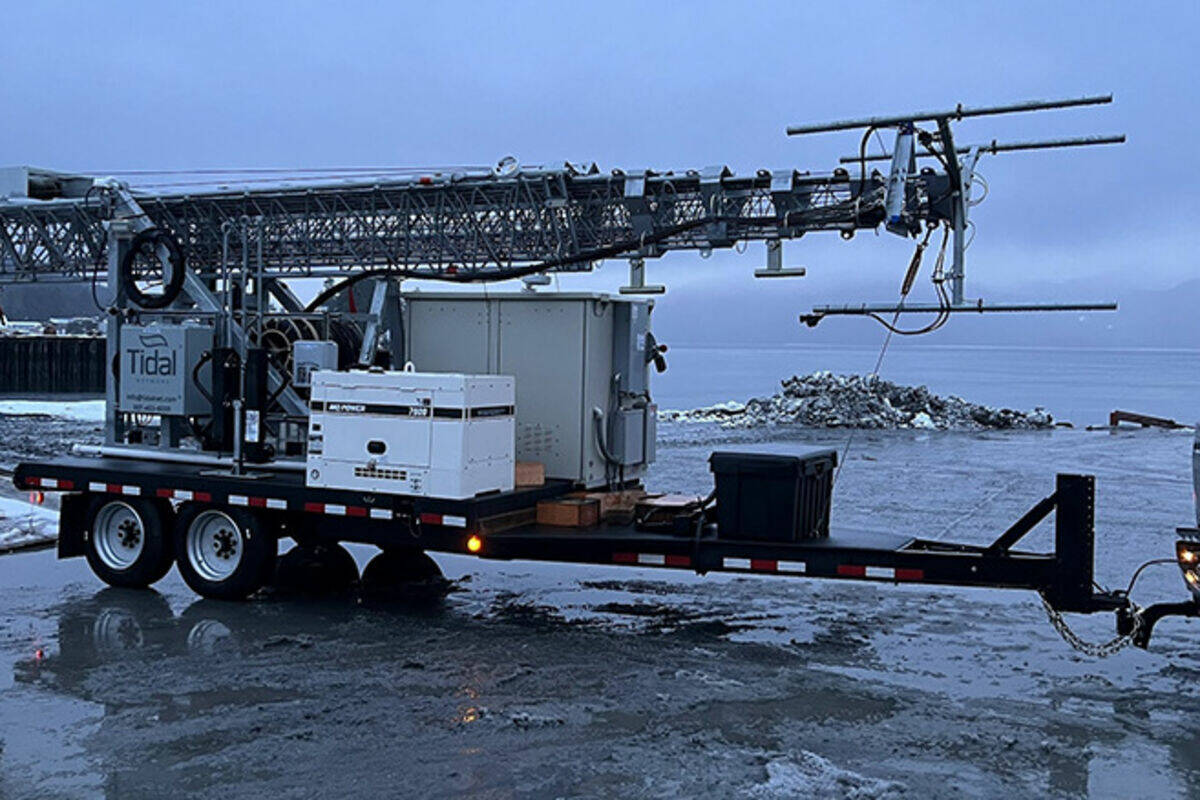
Equipment arriving in Wrangell in January of 2023 has been set up to provide a test wireless broadband system being used by about a dozen households. (Photo courtesy of the Central Council Tlingit and Haida Indian Tribes of Alaska)

Equipment arriving in Wrangell in January of 2023 has been set up to provide a test wireless broadband system being used by about a dozen households. (Photo courtesy of the Central Council Tlingit and Haida Indian Tribes of Alaska)

Testing underway of new Tlingit and Haida wireless internet service

About a dozen Wrangell households using service officials hope to expand elsewhere in Southeast.

Wireless internet service for areas of Wrangell with limited or no access to high-speed downloads should be in operation later this year.

The broadband service initially will start with transmitting and receiving equipment in position atop two existing cell towers, along with two pop-up “cells on wheels (COWS),” explained Chris Cropley, director of the Tidal Network for the Central Council of the Tlingit and Haida Indian Tribes of Alaska.

The portable cell units arrived in Wrangell last week. Each unit cost about $100,000, including electronics and an extendable tower that can reach up to 120 feet high, Cropley said.

“We should see service on the existing towers this year, hopefully, the COWS this year as well,” he said. “We have all the equipment purchased and most of the paperwork in place.”

Tidal Network will lease space on existing towers as a temporary measure until it can obtain land and put up maybe three permanent towers to extend its reach in the community. “We will hopefully see service on the permanent towers in 2024,” Cropley said.

Finding the best sites for the COWS and permanent towers is the issue. “We are held up until we have property. We have several lots in mind and have done a lot of work on the design and options,” he said.

“Once we have the land acquired (for COWS), we can stand them up relatively quickly, within a week or two.”

The plan is to install the portable units “to deliver broadband to people on the edges of town,” Cropley said. Later, “we will build permanent towers … and move the COWS as needed.”

The new network will cater to “the unserved and underserved first,” by focusing on areas of Wrangell that have limited or no access to high-speed internet.

Tidal Network will be available to tribal and non-tribal citizens. The anticipated cost is $75 per month for the base program, which will be slower than commercial broadband in areas served by fiber optic but will be fast enough for video conferencing and most streaming.

The wireless broadband service is intended to fill the gap in areas where fiber optic is not a feasible option.

Tlingit and Haida is using federal pandemic aid to pay for its Tidal Network pilot projects in Wrangell and Sitka.

Separate from the pilot project, the Central Council last November announced it had received a $50 million federal grant for broadband infrastructure, part of the Tribal Connectivity Program funded by the 2021 federal Bipartisan Infrastructure Law.

The new money will go toward building 30 towers in more than 20 communities across the region, Cropley told a gathering of the Southeast Conference in Juneau last week.

The plan includes extending broadband services to “truly remote” locations, such as fish camps, he said.

This story originally appeared in the Wrangell Sentinel.

More in News

The emergency cold-weather warming shelter is seen in Thane on Thursday, April 10, 2025. (Jasz Garrett / Juneau Empire file photo)
Man charged for alleged rape at warming shelter

Staff have increased the frequency of safety rounds, and are discussing potential policy changes.

Photo by James Brooks/Alaska Beacon 
Alaska Gov. Mike Dunleavy speaks during a news conference in Juneau on Thursday, April 27, 2023. To his side is a screen displaying significant budget deficits and exhausted savings accounts if oil prices perform as expected.
Disasters, dividends and deficit: Alaska governor unveils first-draft state budget

In his final year, Gov. Dunleavy again proposes to spend from savings in order to pay a larger Permanent Fund dividend

Eaglecrest Ski Area as seen in a photo posted to the hill’s Facebook page on Tuesday, Dec. 11, 2025. (Eaglecrest Ski Area photo)
Eaglecrest boots up for a limitted opening this weekend

15 degree highs usher in the hill’s 50th season.

Sen. Jesse Bjorkman, R-Nikiski, speaks Wednesday, April 23, 2025, on the floor of the Alaska Senate. (Photo by James Brooks/Alaska Beacon)
State senators express skepticism about proposed Juneau ferry terminal backed by Dunleavy

In a Friday hearing, members of the Alaska Senate spoke critically about… Continue reading

SouthEast Alaska Regional Health Consortium is one of the primary health care providers in Juneau, accepting most major public and private insurance plans. (Mari Kanagy / Juneau Empire)
Marketplace health premiums set to rise in 2026

Here’s what you need to know about how coverage is changing, and for whom.

Capital City Fire/Rescue completes last season’s ice break rescue training at the float pond near Juneau International Airport. (photo courtesy of Capital City Fire/Rescue)
On thin ice: Fire department responds to season’s first rescue at Mendenhall Lake

This week’s single digit temperatures have prompted dangerous ice ventures.

Brenda Schwartz-Yeager gestures to her artwork on display at Annie Kaill’s Gallery Gifts and Framing during the 2025 Gallery Walk on Friday, Dec. 5. (Mari Kanagy / Juneau Empire)
Alaska artist splashes nautical charts with sea life

Gallery Walk draws crowds to downtown studios and shops.

A totem pole, one of 13 on downtown’s Totem Pole Trail in Juneau, Alaska, Nov. 27, 2024. (Christopher S. Miller/The New York Times)

Most Read